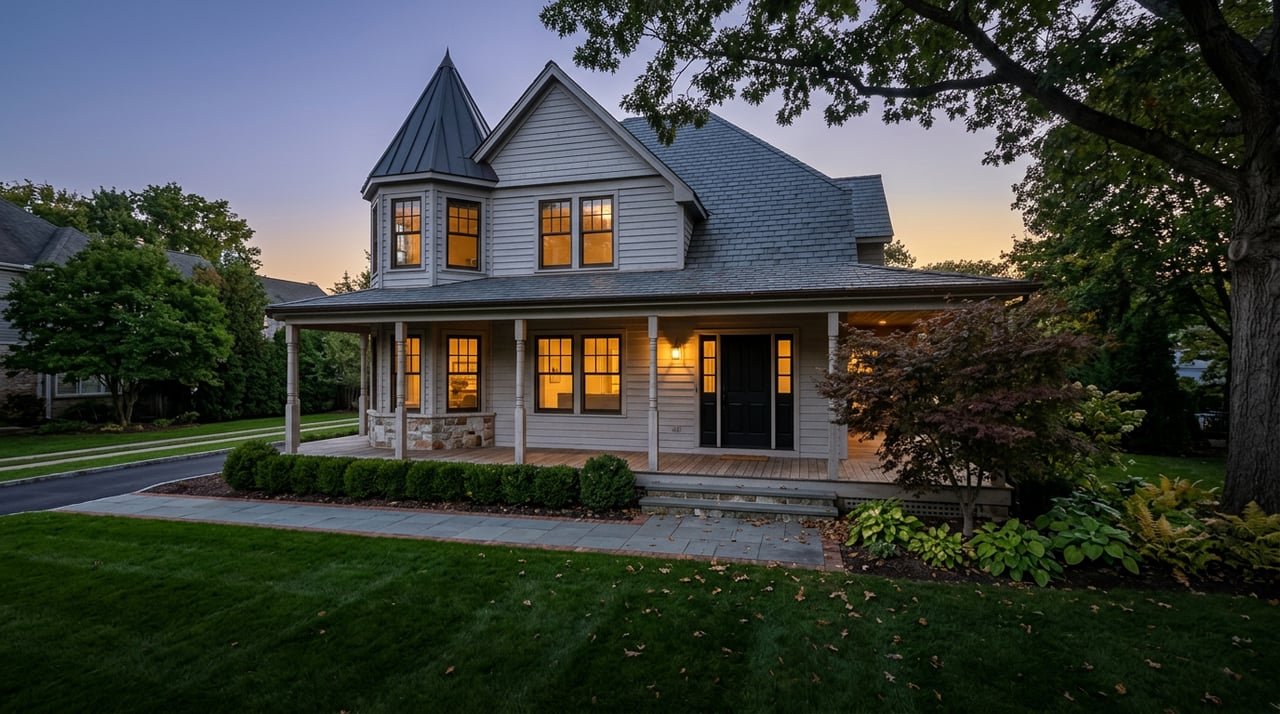
Picture two listings pulled up side by side. Both say "Falls Church, VA." Both sit within a five-minute drive of Broad Street. Similar square footage, similar era of construction, similar asking price. A buyer comparing them on price per square foot alone would call it a coin flip.
It isn't. One of those homes pays its property taxes to the independent City of Falls Church, a 1948 breakaway from Fairfax County built around just over two square miles, according to Wikipedia's entry on the city. The other pays Fairfax County, sends its kids into a much larger public school district, and sits inside a mailing footprint that stretches for miles past anything a City resident would call their neighborhood. Same words on the envelope. Two different governments deciding the tax bill, the school assignment, and a real share of what the home is worth.
That gap, not the median price, is what's worth understanding before an offer goes in.
A City Built to Be Small on Purpose
Falls Church gained township status inside Fairfax County in 1875 and voted to become its own independent city in 1948. The city's own account of its history ties that separation directly to schools: residents wanted a small system they could run themselves rather than one piece of a much larger county district. What they built stayed small by design, just over two square miles with its own government, its own tax rate, and its own district, Falls Church City Public Schools, home to Meridian High School and Mary Ellen Henderson Middle School.
The name traveled further than the boundary did. The U.S. Postal Service still assigns "Falls Church" to a wide swath of Fairfax County that was never inside city limits, covering places like Pimmit Hills, Seven Corners, Merrifield, and Bailey's Crossroads, according to the city's own address finder tool. None of those four neighborhoods pay city taxes or attend city schools. All four show up on a listing sheet exactly the same way a home three blocks from City Hall does.
Same Envelope, Different Government
| City of Falls Church | Fairfax County, "Falls Church" address | |
|---|---|---|
| Governing body | Independent city government | Fairfax County Board of Supervisors |
| Land area | Just over 2 square miles | Spread across many square miles of the county |
| Primary ZIP | 22046 | 22041 through 22044, among others |
| School system | Falls Church City Public Schools | Fairfax County Public Schools |
| Sets its own tax rate | Yes | No, follows the county rate |
Even that table needs a footnote, which is part of the point. The city's own address finder notes that a handful of properties technically sit in ZIP codes 22042, 22044, and 22205 while still falling inside city limits. ZIP code alone is a clue, not proof.
Why the Tax Bill Isn't the Same Bill
Fairfax County's 2026 real estate assessments show an average residential increase of 3.99% countywide. The City of Falls Church's own 2026 assessment, effective January 1, 2026, tells a different story: total taxable assessed value rose 6.9% to $6.86 billion, and residential values specifically climbed 7.2%, with single-family homes up 8.1%, townhomes up 7.0%, and condos up 3.2%, according to the city's real estate assessment office. The City's residential values are appreciating at close to double the county's overall pace in the same cycle. A two-square-mile footprint with a fixed housing supply and a school system people move specifically to access is repricing faster than the much larger county area that borrows its name.
That difference lands in real dollars. Property tax analytics for the current tax year show median bills across the Falls Church mailing footprint ranging from $4,249 in the 22041 ZIP to $10,080 in 22046, according to Ownwell's Falls Church tax data. Two homes that both say Falls Church on the envelope can carry a tax gap north of $5,800 a year, driven almost entirely by which side of an invisible line the parcel sits on.
The School Boundary Even the Map Gets Wrong
Fairfax County Public Schools groups this area into what it calls Region 2, which includes the Falls Church, Justice, and McLean pyramids. That grouping is part of why two nearby addresses in the county can land in different schools even when they sound like they belong to the same place. Buyers weighing a county-side Falls Church address against a home in McLean are often comparing pyramids within the same region rather than two unrelated markets.
The lines aren't fixed. FCPS approved boundary changes in January 2026 that begin phasing in for the 2026-27 school year, meaning a school assignment that looks settled on a listing sheet today isn't guaranteed to hold for a family closing next spring.
The City's boundary has shifted before over something as unglamorous as water pipes. When Fairfax Water purchased the City of Falls Church's water system a few years back, Fairfax County handed over the land under the city's own middle and high schools as part of the deal, land that had technically sat just outside city limits. That's why the City's boundary today bulges slightly around the 22043 ZIP code, according to Greater Greater Washington's history of the boundary.
Where the Line Shows Up in the Sale Price
Pimmit Hills is a useful example because it sits entirely in Fairfax County, uses Falls Church as its mailing address, and attends George C. Marshall High School rather than a Falls Church City school. As of October 2025, public sale records put the typical Pimmit Hills home at $1.5 million, a figure that reflects large new construction replacing the neighborhood's original 1950s-era ranchers rather than pure appreciation on the older housing stock itself. Add-ons, second-floor expansions, and full teardown-rebuilds are common there, block by block.
In other words, part of that price isn't a Falls Church premium at all. It's a construction-year premium wearing a Falls Church mailing address. A buyer pricing that home purely against a City of Falls Church listing is comparing land value plus new construction on one side against jurisdiction and school-district scarcity on the other. They can land on similar numbers for very different reasons, and the reason matters for what happens to that value over the next decade.
How to Check Before You Write an Offer
- Look up the parcel using the City's official address finder and check the field labeled "County." It will name the jurisdiction directly rather than leaving you to guess from the ZIP code.
- Use the city's own rules of thumb as a first filter: most addresses numbered 1400 and above sit outside city limits, and homes fronting Leesburg Pike, Route 7, Arlington Boulevard, Route 50, Lee Highway, or Route 29 are unlikely to be inside the City.
- Confirm current school assignment directly with the district rather than trusting the listing sheet, especially with boundary changes already approved for the 2026-27 school year.
- Ask for the seller's actual, most recent tax bill rather than an estimate. City and County bills are calculated, billed, and due on different schedules, and an online estimator won't catch which one applies.
FAQ
Does a 22046 ZIP code guarantee a home is inside the City? Mostly, but not entirely. The city's address finder confirms 22046 as the primary city ZIP, with a small number of properties also inside city limits under 22042, 22044, and 22205. The parcel-level lookup is the only way to be certain.
Is a City home automatically the better buy? Not automatically. The two markets serve different priorities. The City's small footprint carries a single, community-run school district and faster-appreciating assessments funding its own government. The surrounding county area covers far more ground, more housing types, and multiple FCPS pyramids, some of which are strong in their own right. Which one fits depends on budget and school priorities, not on which one wins.
Could a school assignment change after we move in? Yes. FCPS has been explicit that no residential address is guaranteed to keep the same assignment permanently, and the changes approved in January 2026 are already set to phase in for the 2026-27 school year. If school assignment is central to your decision, verify it again close to the time you write the offer, not months earlier during the first round of touring.
A five-minute jurisdiction check now can prevent a five-figure surprise later. If you're comparing homes across the Falls Church mailing footprint and want someone who already knows exactly where that line runs, block by block, Cristina Sison and her team can walk through the specific parcel with you before you write anything. Visit our Falls Church neighborhood guide to start exploring, or Schedule a Consultation to get a clear read on which government, which schools, and which tax bill actually come with the address you're considering.